
Currituck Projected and Actual Dates
A projected release date, often shortened to PRD in North Carolina correctional material, is the state system's current estimate for when a prison custody phase may end. NCDAC policy also uses “max out” in some settings. Neither phrase means the person has left. Sentence audits, earned credit, court changes, discipline, and later events can alter the estimate. The actual release date is retrospective. It records the departure event after it occurs.
The distinction is different for the Currituck County Detention Center. Many people there await trial. A pretrial detainee does not have a prison PRD because no active prison sentence is being served. Bond may be posted, a judge may change conditions, the case may end, or another hold may control. Some people serve a local post-trial sentence, but the county publishes no online calculation policy. Their date must come from the filed judgment and the lawful calculation maintained by the Currituck custodian.
Scheduled is not actual. A projected date supports planning. Only the latest source-agency record can confirm that Currituck or NCDAC custody ended and show whether the event was release or transfer.
A transfer can close one record without putting the person in the community. If Currituck sends a sentenced person to NCDAC, the local episode ends and the state prison record becomes the correct source. A federal or immigration transfer starts another branch. The phrase “released from Currituck custody” should not be expanded to “free” unless the receiving-custodian question is resolved.
Find Currituck Inmate Release Dates
Start with the custody type, not a date calculator. The NCDAC criminal offender searches gateway says its public systems cover state prisoners, probationers, and parolees while excluding county-jail information. That boundary prevents a common mistake: using a state record to estimate a short Currituck jail stay. The person's state offender number is the strongest OPI search key when known. Otherwise, compare name, age or date information, physical descriptors, conviction county, and each displayed episode.
- Identify whether the person is pretrial in Currituck County, serving a local sentence, committed to NCDAC, or held by another sovereign.
- For NCDAC custody, open the official OPI search, match the person by offender number or careful identity comparison, and read all incarceration and supervision sections.
- Copy the exact field label and value shown for projected release, actual release, or sentence service. Save the page's access or update date.
- For a Currituck sentence, obtain the filed commitment or judgment and ask the Detention Center for its current calculation.
- For a pretrial person, follow bond and court orders instead of trying to compute a sentence date. Ask about any separate hold.
- After the date passes, confirm the event through the responsible custodian and a status notification source.
OPI history reaches back to 1972, but it is not a Currituck booking archive. A prior actual release line can coexist with a later admission or an active community-supervision entry. Read the newest episode. The Currituck County released inmate lookup gives the full county, court, state, federal, and immigration branches when the custodian is uncertain.
Note: A missing projected date can mean the field is unavailable or inapplicable; it does not establish that release occurred.
Currituck Release Date Record Fields
An OPI detail record can carry several dates and status lines. Each belongs to a specific sentence or supervision episode. Do not lift one date from an older incarceration and apply it to the person's current status. A state release-search result may also be reached through NCDAC's month-and-county Inmate Releases search, but that tool lists state correctional events. Selecting Currituck as the county does not turn it into a list of people who bonded out of the county jail.
| State record field | What it can establish |
|---|---|
| Offender number | Identifies the state record and reduces the chance of a name-only mismatch. |
| Inmate status | Shows the public state custody status for the relevant episode. |
| Projected release | Shows NCDAC's current estimated prison end point when that field is present. |
| Actual release | Records a completed departure from the identified state incarceration episode. |
| Minimum and maximum terms | Provide the sentence framework used with applicable statutes and earned-time rules. |
| Supervision status | Can show probation, post-release supervision, parole, inactive status, or an absconder entry after confinement. |
| County, docket, and offense | Connect the state episode to the conviction record and help confirm identity. |
When a formal state record is needed, the NCDAC public-records channel holds public admission and release dates, time served, sentence length, and basic conviction information for people who served in a DAC prison or were under state supervision. It does not hold local jail records. A Currituck request belongs with the Sheriff's Office, and the judgment belongs with the Currituck Clerk.
North Carolina Minimum-Term Rule
North Carolina structured sentencing should not be reduced to the claim that every prisoner serves 85 percent. The governing rule begins with the judicial minimum. G.S. 15A-1340.13(d) provides that an offender with an active felony punishment must serve the minimum term, subject to its cited exception. Earned time may reduce the maximum term, but not below the minimum. G.S. 15A-1340.17 supplies minimum and maximum tables and post-release additions for ordinary structured sentences. Offense-specific law can change the ordinary pattern.
The official minimum-term statute page shows the rule that should anchor a Currituck County prison release date explanation.
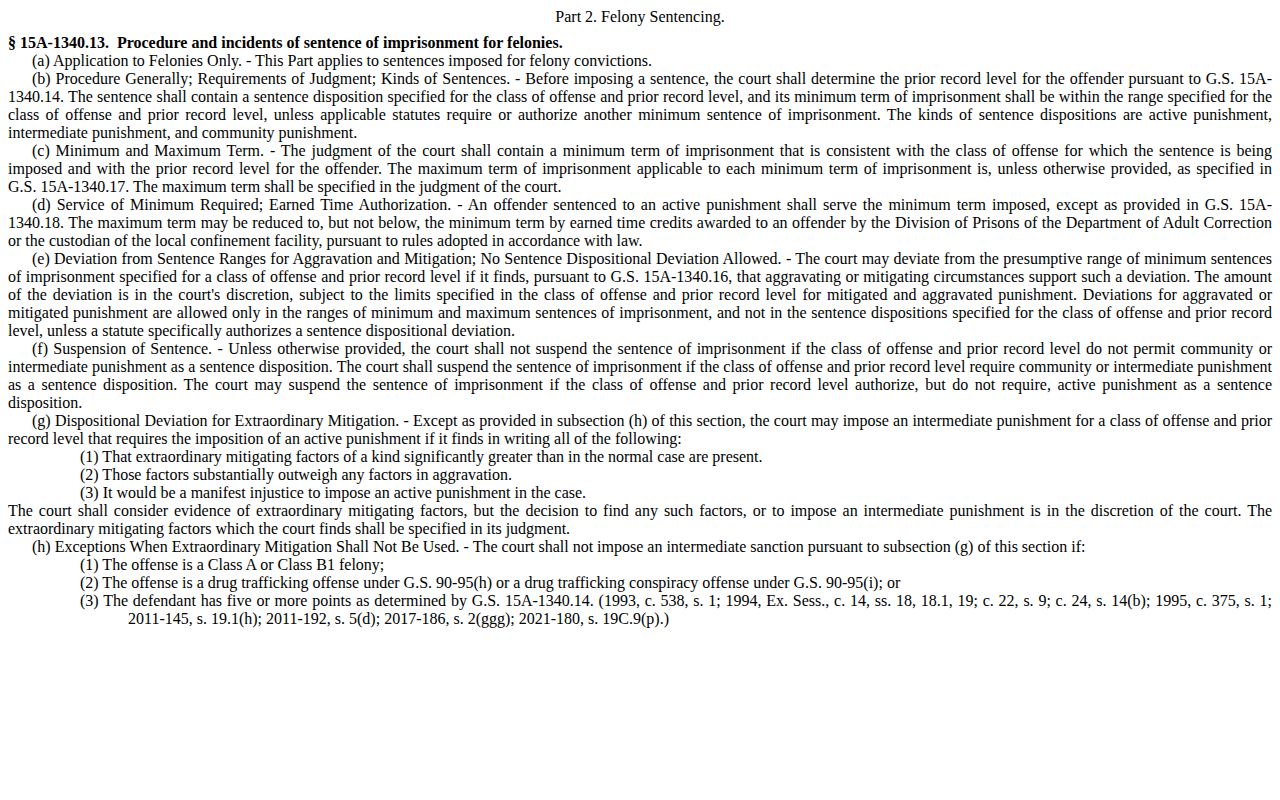
The statute supports service of the minimum and limits earned-time reduction, rather than promising one percentage or a hand-calculated date.
G.S. 15A-1368.2 governs post-release timing for structured sentences. It sets intervals before the maximum for different felony classes, incorporates earned time, addresses supervision lengths, and limits earned-credit reduction of supervision. Post-release supervision means the person has left prison but remains under Community Supervision and the Post-Release Supervision and Parole Commission. It is not the same as full discharge.
Note: Earned time may move a maximum toward the judicial minimum, but it cannot create a date earlier than the governing sentence and law permit.
Currituck County Sentence Calculations
A local misdemeanor or other county sentence follows a different record path. Obtain the signed judgment or commitment first through the Currituck County court. It states the term imposed and may resolve whether terms run together or one after another. Then ask the Currituck County Detention Center for the custodian's calculation, including credit reflected in the record. North Carolina law may permit earned time in local confinement under lawful rules, but no public Currituck calculation policy was found in the reviewed county sources.
That negative finding matters. A prison term table should not be pasted onto a county sentence. A customary weekend rule from another jail should not be assumed. Nor should days be counted from a docket summary without checking jail credit, the filed judgment, or another case. If the date is disputed, request the existing calculation rather than asking staff to create a new legal analysis.
- Jail credit
- Time the lawful sentence calculation credits toward the term, subject to the judgment and controlling law.
- Concurrent terms
- Terms that run at the same time when the judgment and law so provide.
- Consecutive terms
- Terms served one after another, which can move the projected end point.
- Detainer
- A request or hold from another authority that can change where the person goes when one custody phase ends.
- Discharge
- Completion of the relevant custody or supervision obligation, which is broader than release from a building.
For a probation sentence, there may be no prison PRD at all. Probation is supervision ordered by the court, often with a suspended sentence. A later revocation can create a new custody calculation. The current judgment and state supervision record must be read together.
Why Currituck Release Dates Move
A projected date is recalculated when an input changes or a sentence is audited. Some changes affect the displayed end date. Others leave the NCDAC date intact but change the person's destination. A detainer is a clear example: the state prison phase may end on schedule while another custodian takes control. That is a release from one agency, not necessarily a return to the community.
| Factor | Possible effect on the release date or event |
|---|---|
| Sentence audit | Corrects the term structure or another calculation input in the official record. |
| Jail-credit correction | Adds or removes qualifying prior-custody credit after review. |
| Earned-time award or loss | Moves the maximum-term calculation within the statutory floor. |
| Disciplinary action | May reduce credit and move the projected date later. |
| Amended court judgment | Changes the legal sentence terms the custodian must carry out. |
| Concurrent or consecutive correction | Changes whether terms overlap or run one after another. |
| Revocation, escape time, or new sentence | Can add custody time or create a later controlling episode. |
| Commission or medical action | May alter release timing for a legally eligible case. |
| Detainer or transfer order | May change the destination even when the displayed NCDAC date arrives. |
Traditional discretionary parole has limited reach in modern North Carolina cases because structured sentencing applies to offenses committed on or after October 1, 1994. The Commission handles older-law and specified statutory categories, while post-release supervision is the usual modern term. A parole review, grant, denial, or revocation must be tied to an eligible case rather than treated as an automatic part of every release calculation.
Weekend State Release Timing
An older official NCDAC release-procedure policy says scheduled post-release-supervision releases proceed on weekends and holidays. It also describes institutional escalation when a planned release has not been completed by late afternoon. That detail belongs only to the state-prison process described by the policy. It does not establish Currituck County Detention Center release hours, a pickup door, a family waiting area, or a local weekend practice.
No official Currituck release-time or weekend procedure was identified. Families should confirm timing and destination with the Detention Center before making plans. A date on a court record or OPI screen does not promise the physical processing hour. Transportation, paperwork, another hold, and the receiving agency can affect what happens at the end of the custody episode.
This state-versus-county distinction is a useful computation safeguard. The same calendar date can describe a planned prison release, a local sentence end, a court event, or the start of supervision. Always preserve the field label and source instead of calling every one of them “the release date.”
Confirm a Currituck Release Date
After a projected date passes, return to the source record. In OPI, look for an actual release field and read any current post-release, parole, probation, or later incarceration entry. For Currituck County, ask for the release timestamp, release authority or type, booking number, and whether the event was a community departure or transfer. The filed court judgment explains the legal sentence, but the jail or prison event records the physical custody change.
NC SAVAN can provide a projected-release or actual-release notice based on participating agency data. The Currituck County VINELink release check explains how to match the person and register for a notice. Treat the alert as a prompt to verify. A changed or vanished PRD is not proof of release, and a released SAVAN label does not rule out another custodian.
Record the access date and the exact source wording. When records conflict, describe the scope of each one: released from Currituck custody, released from NCDAC incarceration to supervision, or no longer in a named federal custody system. That phrasing is more accurate than a broad claim and makes the projected-versus-actual distinction clear.